Ask anyone who grew up in a small town to describe its Main Street and you’ll get a list. The hardware store with the wooden floor that creaked. The five-and-dime with a candy counter at the front. A soda fountain, a barbershop with a striped pole, a bank with its name carved in stone over the door, and at the end of the street, a depot or a courthouse or a white church with a steeple.
The details change from town to town, but the shape is the same: a few blocks where nearly everything a family needed sat within walking distance, and where you couldn’t run an errand without running into someone you knew.
For a lot of towns, that street went quiet in the second half of the twentieth century. Some of it came back. Here’s how both happened.
What changed
No single thing emptied Main Street. It happened over decades, and a few turning points stand out.
The highway went around town. On June 29, 1956, President Eisenhower signed the act that created the Interstate Highway System, authorizing 41,000 miles of road to be built over about thirteen years (National Archives). The new highways were fast, and they often bypassed the towns the old two-lane roads ran straight through. Travelers who used to stop for lunch and gas on Main Street now stopped at the interchange, or didn’t stop at all.
Shopping moved indoors. Later that same year, on October 8, 1956, Southdale Center opened in Edina, Minnesota. Designed by the architect Victor Gruen, it’s generally counted as the first fully enclosed, climate-controlled shopping mall in the country (Southdale Center). Malls soon followed in suburbs everywhere, with free parking, air conditioning and a dozen stores under one roof, and in a Michigan January that’s a hard offer to turn down.
The big stores came to small towns. Sam Walton opened the first Walmart on July 2, 1962, in Rogers, Arkansas (Walmart). Discount chains built on the edge of town, where land was cheap and parking was plentiful, and they could sell for less than the hardware store and the dry goods store downtown.
Then the internet. By the time online shopping arrived, many Main Streets had already lost their department stores and five-and-dimes. Ordering from home took some of what was left.
The buildings stayed, though. Brick storefronts with apartments upstairs don’t go anywhere just because the tenants do, and that turned out to be the start of the comeback.
Main Street comes back
In 1977, the National Trust for Historic Preservation tried an experiment in three small towns: Galesburg, Illinois; Hot Springs, South Dakota; and Madison, Indiana. Rather than tearing down old downtown buildings, the towns would fix them up and fill them with businesses again. The lessons from those three became the Main Street approach, and in 1980 the Trust founded the National Main Street Center to take it nationwide (Main Street America).
The organization, now called Main Street America, says more than 2,000 communities have used its framework, and it credits the work with more than 356,000 building rehabilitations and 188,000 new businesses. Those are the program’s own figures, but you can see the results in plenty of towns: a coffee shop where the bank used to be, a bookstore in the old five-and-dime, a farmers market in the square on Saturday mornings.
The new Main Street isn’t the old one. The hardware store may be a brewpub now, and the depot may be a museum. But the idea that a town ought to have a center, a place you walk to and run into your neighbors, has turned out to be hard to kill.
Test your Main Street memory
Four questions for anyone who remembers the soda fountain, or wishes they did. Answers are below.
- Frank Woolworth’s first “Great Five Cent Store” opened in Utica, New York, in February 1879 and closed that May. His second try, in June of the same year, succeeded. In what state was it?
- Why was the person behind the soda fountain called a “soda jerk”?
- Route 66 ran down the Main Streets of hundreds of towns between Chicago and Los Angeles. In what year was it officially removed from the U.S. Highway System?
- Mark Twain grew up in a Mississippi River town that became St. Petersburg in The Adventures of Tom Sawyer. What’s the town’s real name?
Answers
- Pennsylvania. The store in Lancaster opened on June 21, 1879 (F. W. Woolworth Company).
- It’s a play on “soda clerk,” the drugstore job title, and on the jerking motion of pulling the fountain’s tap handle (Soda jerk).
- 1985. The last town it ran through to be bypassed by the interstate was Williams, Arizona, in October 1984 (The Route 66).
- Hannibal, Missouri.
A stroll down Main Street
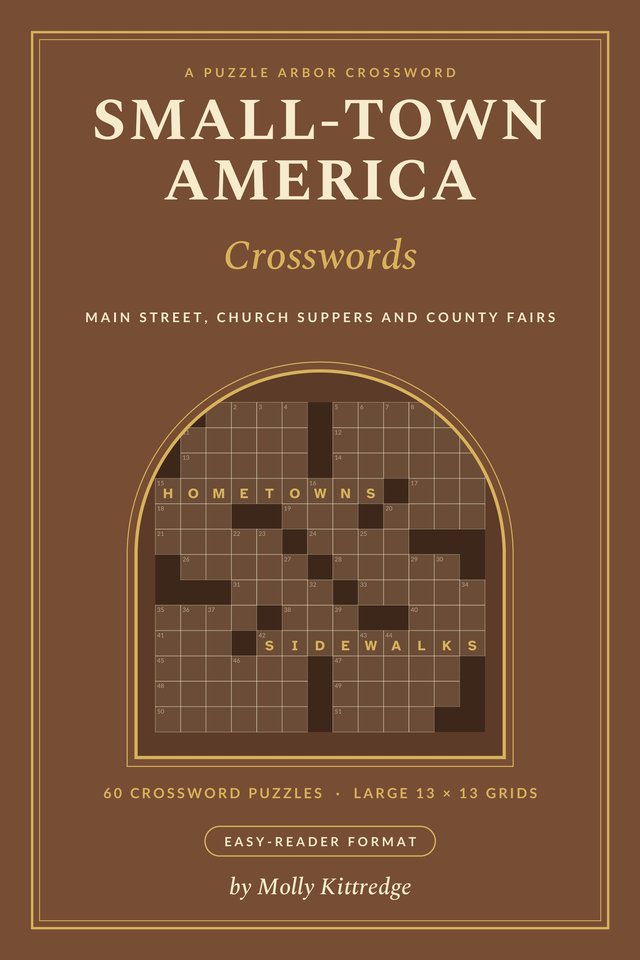
If those questions brought back a few memories, Small-Town America by Molly Kittredge has sixty more ways to spend an afternoon there. It’s part of the Puzzle Arbor Crossword Series, with puzzles on the general store and the barbershop, church bells and potluck dinners, Fourth of July parades and county fair ribbons, the one-room school and the depot. One section visits small towns in story, from Mark Twain’s Hannibal to Norman Rockwell’s Stockbridge, and another looks at small towns today.