

Picture a fellowship hall on a Friday night in December. There are six round tables, a slow cooker of meatballs, and a man in his seventies who has taught Sunday school since the Carter administration sitting next to a sixth grader who has never opened a Bible on her own. The host reads the first question, a true-or-false: Noah took two of every kind of animal into the ark. The man writes “true” with total confidence. The sixth grader figures nobody would ask a question that easy, talks her team into “false,” and she’s the one who’s right.
That’s a made-up scene, but it’s the kind of moment a good trivia night produces. The answer is in Genesis 7:2: “Of every clean beast thou shalt take to thee by sevens, the male and his female” (KJV). Pairs show up a chapter earlier (Genesis 6:19), so the man wasn’t wrong so much as he’d stopped reading too soon. Most of us have. A well-run Bible trivia night lets the veteran and the newcomer both learn something, and it doesn’t leave anyone feeling stupid in front of the church. Here’s how to put one together.
Build teams that mix ages and experience
Left alone, people sit with their friends. The youth group takes one table, the retired couples take two others, and the young families huddle near the door so they can leave early. You end up with a contest between generations, and the table with the longest-serving deacons usually wins.
Assign the teams instead. Four to six people is a workable size: enough to pool what they know, small enough that everyone gets a turn talking. Put at least one teenager and one older adult at every table, and spread out the people who know their Bibles well. You can do this with colored name tags or by numbering people off at the door. Some will grumble about it for about four minutes and then forget they ever minded.
Mixed teams change what the evening is like. The older saint remembers that Elijah was the prophet the ravens fed (1 Kings 17:1–6), and the fourteen-year-old remembers that Methuselah lived 969 years (Genesis 5:27) because the number struck him as ridiculous in Sunday school. Neither could win alone, and they both know it by the third round.
The host carries the night
Choose a host who reads clearly, can be a little funny, and doesn’t mind being interrupted. A host who can read a room is worth more than one who knows every answer, because the answers are on the sheet.
Ten questions makes a good round. Read each question twice, give teams a minute or so to talk it over, and have them write answers down rather than shout them. Shouting rewards the loudest table. Writing gives the quiet person in the corner a chance to say, “I think it’s Zacharias,” and be heard by her own team.
After each round, read the answers aloud with the explanation and the Scripture reference. Don’t skip this part. It’s where people say “I never noticed that,” and it’s the difference between a quiz and a game that sends people back to the text. The Bereans got credit for checking things for themselves: they “searched the scriptures daily, whether those things were so” (Acts 17:11). A trivia night can give a room full of people a reason to do a little of that, even if the motive at first is beating the table by the window.
Keep scoring simple, a point for every correct answer. Have teams swap answer sheets to grade them, or collect them and tally while the next round gets under way. Post the running totals on a whiteboard where everyone can see them. Three to five rounds, with a break for food in the middle, fills an evening without wearing out the youngest players or the oldest.
Keep it kind to people who don’t know much Bible
Some people in your hall will be visitors, new believers, or folks who grew up outside the church. Trivia can make them feel like outsiders in a hurry. A few habits help.
Mix the difficulty. Every round should have a few questions most people can get, so no table ends a round with a zero. Multiple-choice questions are friendlier than open-ended ones, because even someone who doesn’t know the answer can reason toward it. Questions about the Bible’s surprises, the clean animals going in by sevens or the details that differ from the felt-board version, level the field, since longtime churchgoers miss those as often as anyone.
Watch the jokes, too. Teasing a deacon who misses an easy one is part of the fun. Teasing the visitor who did is not. And the host shouldn’t add commentary that makes anyone feel graded on their spiritual life. A wrong answer about Jacob’s sons tells you nothing about the state of someone’s soul.
Snacks, prizes, and where to find the questions
Food can be as simple as a potluck or a table of popcorn, cookies and coffee. Put something on every table so people have a reason to linger at the break. Prizes should be cheap and slightly silly: a homemade trophy, first place in the dessert line, the right to pick the hymn on Sunday if your pastor is a good sport. Give a prize for last place, too. It takes the sting out.
For a family night at home, scale everything down. Two teams, kids paired with grandparents, one round before dinner and one after. Most of the same rules apply, especially the one about writing answers down.
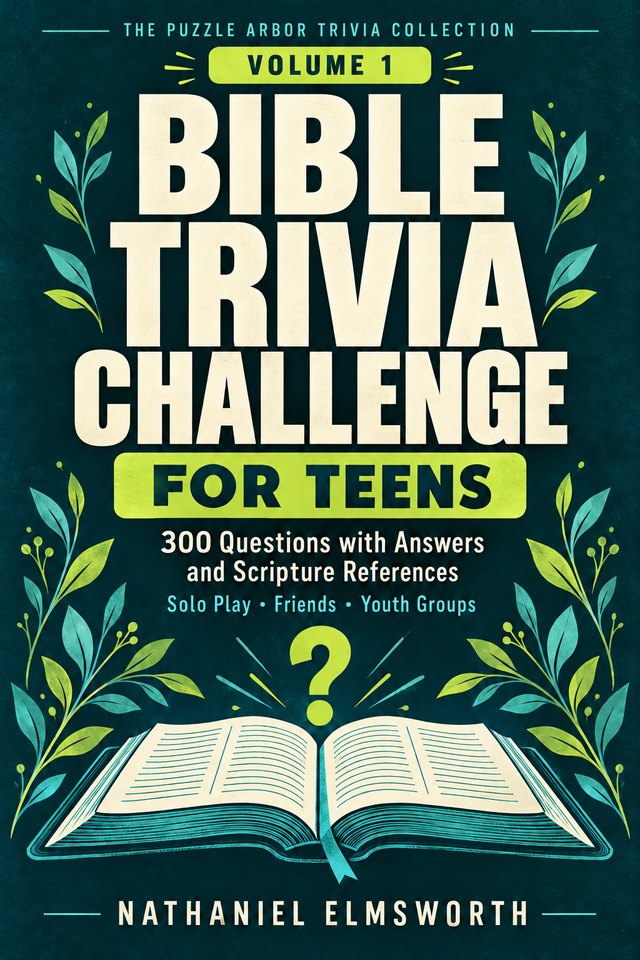
If you’d like questions already written and checked, we have free trivia rounds you can play on screen or print. Each one is the first round of a Puzzle Arbor trivia book, ten questions with answers and short explanations. The Bible rounds include “In the Beginning” from Bible Trivia Challenge for Teens, Volume 1, which covers creation, the garden, the flood and Babel, and “First Pages, Fresh Details” from Volume 2. For a Christmas gathering there’s “Before the Manger: Zechariah,” from Christmas Trivia Challenge, with every answer drawn from Luke 1. Each round prints on two letter-size sheets: hand the questions to each team and keep the answer key for the host.
The full books have 300 questions apiece, in 30 rounds of ten, and every answer comes with a short explanation and a source. Volume 1 of the teen series was written for teens playing solo, with friends or in a youth group. It includes scorecards, simple scoring and tips for group play, and its last round is called “Scripture or Assumption,” which is exactly the kind of round that humbles the know-it-alls. Volume 2 stands on its own, so you don’t need the first book to use it. Christmas Trivia Challenge has scorecards and an optional conversation prompt at the end of each round, and its book page suggests playing in teams that mix teenagers, parents and grandparents.
Whatever you use, the best trivia nights don’t end when someone wins. They end with a teenager and a retired schoolteacher still arguing about Noah’s animals while somebody stacks the chairs.