

Picture a church of about seventy people in a small town. Linda has put together the Sunday bulletin for sixteen years. She also orders the communion cups, keeps the nursery schedule in a spiral notebook, and knows which breaker to flip when the coffee maker in the fellowship hall trips it again. She’s a composite, but if you’ve served in a small church you can probably put a real name on her.
One Sunday after the service she catches the pastor at the door and tells him she’s stepping down at the end of the month. Her daughter in Ohio needs help with the grandchildren, she’s seventy-eight, and she’s tired. She also mentions, a little too casually, that a newer member redid the bulletin template last spring without asking her. Both things are true, the way people’s reasons for leaving a job usually are. The pastor will be grateful for her sixteen years, and he’ll mean it, but if he’s honest the first thing through his head is a question about who else knows the password to the copier.
The faithful volunteer isn’t the problem
It would be easy to turn Linda into a cautionary tale about people who won’t let go, and it would be unfair. Churches like hers stay open because people like her show up. In many small congregations a handful of people have carried the work for decades, often while the church shrank around them and the jobs stayed the same size. Plenty of them asked for help years ago and didn’t get it, or trained a replacement who moved away or lost interest after six weeks.
It’s also true that a role can turn into an identity. When someone has done a job for sixteen years, being asked to teach it to someone else can sound a lot like being asked to clean out her desk. Pastors don’t always handle that conversation well, and a younger volunteer who changes the template without a word doesn’t help. Most of the fault, though, lies with an arrangement nobody chose on purpose: over the years the church let one faithful woman become the only place a piece of its life was kept.
Moses had the same problem
Exodus 18 describes a day when Moses “sat to judge the people: and the people stood by Moses from the morning unto the evening” (Exodus 18:13, KJV). His father-in-law, Jethro, watched the whole thing and told him, “The thing that thou doest is not good. Thou wilt surely wear away, both thou, and this people that is with thee: for this thing is too heavy for thee; thou art not able to perform it thyself alone” (Exodus 18:17–18).
Notice who wears out in Jethro’s warning. Moses does, but so do the people standing in line all day. Jethro’s advice didn’t push Moses aside, either. He kept teaching the people and kept the hard cases. What changed was that “able men, such as fear God, men of truth” (18:21) took the ordinary ones: “so shall it be easier for thyself, and they shall bear the burden with thee” (18:22).
Paul gave Timothy a longer view of the same idea: “the things that thou hast heard of me among many witnesses, the same commit thou to faithful men, who shall be able to teach others also” (2 Timothy 2:2). If you count the generations in that sentence, you get four, from Paul through Timothy and the faithful men to the others they’ll teach. Paul was planning past his own lifetime and past Timothy’s.
Ephesians 4 says Christ gave the church apostles, prophets, evangelists, and pastors and teachers “for the perfecting of the saints, for the work of the ministry, for the edifying of the body of Christ” (Ephesians 4:11–12). Many modern translations drop the first comma, so that leaders are given “to equip the saints for the work of ministry” (ESV). However you punctuate it, Paul has no picture of a church where a few people do the work while the rest look on.
Who could step in tomorrow?
In the Navy, nobody stood a watch alone because they’d read the manual. You stood it “under the instruction and supervision of a qualified watchstander,” as one Navy navigator described the process (U.S. Navy), until you’d shown you could do the job and someone qualified signed you off. A healthy crew always had some of each. I commanded a coastal patrol ship, about as small as commissioned Navy ships got at the time, and on a ship that size there’s no slack. When one person is out sick, everyone can see the hole.
Churches tend to notice the hole only when it opens. A plain place to start is three questions about each role your church depends on: who does it now, who could step in tomorrow, and who is being prepared. Being prepared means someone is learning the role by doing it alongside the person who has it. A binder of instructions is worth having, but reading one won’t teach anybody how to calm a room of toddlers.
Begin with the jobs nobody thinks of as ministry. Who unlocks the building? Who knows the alarm code, pays the electric bill, counts the offering (and with whom), and knows where the deed is kept? Then move on to the visible roles. You’ll find some with a decent bench and some with one name and two blanks, and each blank is a conversation somebody hasn’t had yet.
With someone like Linda, the best version of that conversation happens years before she’s tired. It sounds less like “We need a succession plan” and more like “Would you be willing to show someone how you do this? Nobody does it better.” Plenty of volunteers are glad to be asked. Others say yes and never quite hand anything over, and some apprentices drift off after a month. Even when the asking goes well, Linda may still stop you at the door one Sunday, and the church will scramble. A bench won’t prevent that, though you won’t be starting from zero.
A free map of your church’s bench
The Leadership Bench Map is a free tool built around those three questions. You list your church’s roles, adjust them to fit, and fill in the three columns, plus one for notes. Saving gives you a private link, and anyone with the link can see and change the plan, so a pastor and a board can work on it together.
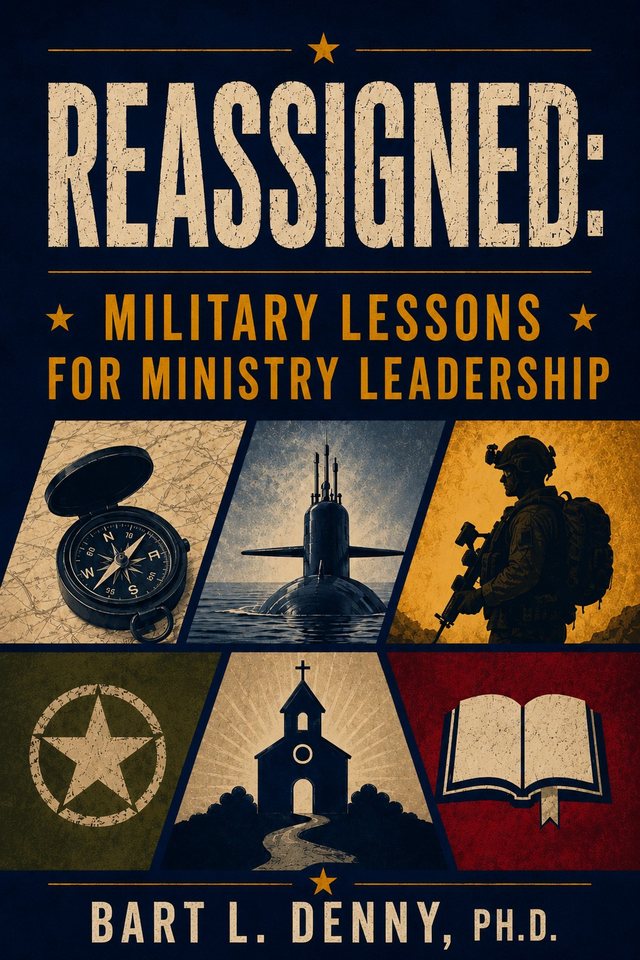
The map comes from Chapters 17 and 18 of Reassigned, which puts the idea this way: “Not ready for everything is different from ready for nothing.” For my doctoral research I interviewed eleven pastors who’d led small churches through revitalization, and I asked them how they’d developed new leaders. Seven of the eleven were veterans, and the book grew out of that research and out of a question it raised: what does military service form in people that can be put to use in Christ’s service, and what has to be adapted for the church?
If your church has a Linda, she probably isn’t leaving this month. You might thank her this Sunday, and then ask whether she’d be willing to teach someone what she knows.