

The first page of the New Testament is a list of names. Most of us skim it on the way to the manger, and I’ve done my share of skimming. But Matthew put that list first on purpose, and his opening sentence names two men who had been dead for centuries: “The book of the generation of Jesus Christ, the son of David, the son of Abraham” (Matthew 1:1, KJV).
Each of those names carried a promise, and Matthew’s first readers would have heard them the way an old sailor hears the name of a ship he served on. Christmas, as Matthew tells it, doesn’t begin in Bethlehem. It begins with God giving his word to people who would never live to see him keep it.
A promise in a garden, and another to a wanderer
The earliest of those promises comes in the worst chapter of Genesis. Adam and Eve have eaten the forbidden fruit, and God is pronouncing judgment on the serpent: “And I will put enmity between thee and the woman, and between thy seed and her seed; it shall bruise thy head, and thou shalt bruise his heel” (Genesis 3:15).
Christians have long called this verse the protoevangelium, the “first gospel.” Irenaeus, a bishop in what is now Lyon, France, was already reading it as a promise about Christ around AD 180 (Against Heresies 5.21, New Advent). In fairness, the verse is compressed, and interpreters still argue about how much it says by itself (New Catholic Encyclopedia). But the shape of it is hard to miss. In the same breath as the curse, God speaks of a descendant of the woman who will crush the serpent’s head and be wounded in the doing.
A few chapters later, God calls Abram away from his country and his kindred with nothing but a promise: “and in thee shall all families of the earth be blessed” (Genesis 12:3). After Abraham didn’t withhold Isaac, the promise came again with an oath and the word seed: “And in thy seed shall all the nations of the earth be blessed” (Genesis 22:18). Paul reads that singular noun as pointing to one person, “which is Christ” (Galatians 3:16). Mary’s song, sung before Jesus was born, ends with God remembering what “he spake to our fathers, to Abraham, and to his seed for ever” (Luke 1:55).
A scepter, a throne and a long silence
When the dying Jacob blesses his sons, he gives Judah a strange line: “The sceptre shall not depart from Judah, nor a lawgiver from between his feet, until Shiloh come; and unto him shall the gathering of the people be” (Genesis 49:10). Nobody is quite sure what “Shiloh” means; the NIV renders it “until he to whom it belongs shall come” and admits in a footnote that the Hebrew is uncertain. Ancient Jewish readers heard a king in it anyway. The Aramaic paraphrase known as Targum Onkelos reads it as “until Messiah come” (Ellicott’s Commentary, Bible Hub).
Centuries later the scepter landed with David, a son of Judah. Once he was settled in a cedar palace, David wanted to build God a house, and God answered through Nathan the prophet that he would build David a house instead, a dynasty: “I will set up thy seed after thee… and I will stablish the throne of his kingdom for ever” (2 Samuel 7:12–13).
Here the story gets uncomfortable, and I don’t think we should hurry past it. In 587 or 586 BC the Babylonians broke through Jerusalem’s walls. Zedekiah, Judah’s last king, watched his sons killed, was blinded and was carried off to Babylon, and Judah stopped being a kingdom (Britannica). For the next several hundred years, a throne promised “for ever” sat next to the plain fact that no son of David was on it. Matthew doesn’t hide this. His genealogy marks “the carrying away into Babylon” as one of its turning points (Matthew 1:17), and the king in Jerusalem when Jesus was born was Herod, an Idumaean whom the Roman senate had named king (EBSCO Research Starters).
Against that background Gabriel tells a young woman in Nazareth that her son will receive “the throne of his father David” and that “of his kingdom there shall be no end” (Luke 1:32–33). Anyone who knew 2 Samuel 7 would have felt those words land.
Isaiah, Micah and how the Gospels read them
Isaiah’s famous sign was first given to a frightened king. Ahaz of Judah had the armies of Syria and northern Israel coming at him (Isaiah 7:1–2). Told to ask God for a sign, he refused, so God gave one anyway: “Behold, a virgin shall conceive, and bear a son, and shall call his name Immanuel” (Isaiah 7:14).
The Hebrew word here, ‘almah, means a young woman of marriageable age and doesn’t by itself specify virginity. The Jewish translators of the Septuagint, the Greek Old Testament made in the centuries before Christ, chose parthenos, the ordinary Greek word for a virgin, and that’s the wording Matthew quotes (Matthew 1:23). Some evangelical interpreters see a sign with meaning for Ahaz’s own day and a fuller meaning that became clear only in Mary; others read it as a direct prediction. Either way, Isaiah himself pushed past Ahaz two chapters later, toward a child whose names include “The mighty God” and whose government would sit “upon the throne of David” without end (Isaiah 9:6–7).
Micah, Isaiah’s contemporary, supplied the address: “But thou, Bethlehem Ephratah, though thou be little among the thousands of Judah, yet out of thee shall he come forth unto me that is to be ruler in Israel” (Micah 5:2). When Herod asked where the Christ would be born, the chief priests and scribes quoted Micah without hesitation (Matthew 2:4–6). They knew the verse cold. Matthew never mentions any of them making the short trip south to go and look.
Reading Advent from the beginning
After the resurrection, Jesus walked with two discouraged disciples and, “beginning at Moses and all the prophets, he expounded unto them in all the scriptures the things concerning himself” (Luke 24:27). You can read the Christmas story the same way, starting well before Luke 2. Read Genesis 3, 12 and 49, then 2 Samuel 7, then Isaiah 7 and 9 and Micah 5, and only then Matthew 1–2 and Luke 1–2. Leave time to feel the centuries between them. Hebrews says the people of Genesis “died in faith, not having received the promises, but having seen them afar off” (Hebrews 11:13).
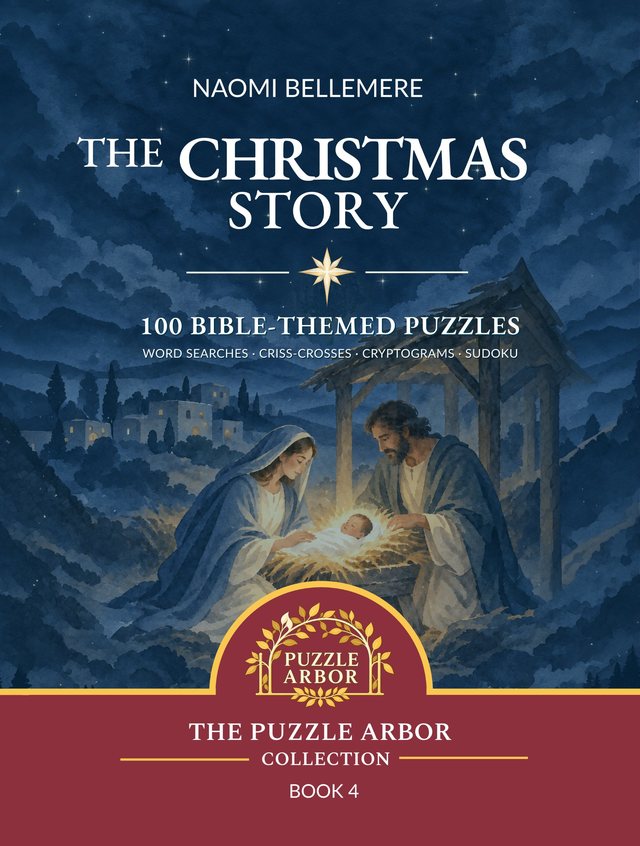
Our free Advent Puzzle Calendar takes a lighter route through the same season, with a King James Version puzzle each morning from December 1 to Christmas Eve and a bonus on Christmas Day. Our Puzzle Arbor book The Christmas Story walks the whole path in 100 puzzles (word searches, criss-crosses, cryptograms and Sudoku), starting with “The Seed of the Woman” and “The Promise to Abraham” and moving through Gabriel, Bethlehem, the shepherds and the wise men. It closes with John 1:14: “And the Word was made flesh, and dwelt among us.” Solutions are in the back, so nobody has to stay stuck on a cryptogram until Epiphany.
Paul put the long wait into one sentence: “For all the promises of God in him are yea, and in him Amen” (2 Corinthians 1:20). Abraham, David and Isaiah heard the promise and never heard the amen. We live on the other side of Bethlehem and are still waiting on parts of the same promise, which may be reason enough to read the old ones slowly this December.