On December 8, 2023, the Food and Drug Administration approved the first two gene therapies for sickle cell disease, an inherited blood disorder that brings crippling pain, organ damage and an early death to many who have it. One of the two, Casgevy, was the first therapy the FDA had ever approved that uses CRISPR gene editing (FDA). Doctors take a patient’s own blood stem cells, edit them, and return them to the body.
It’s hard to imagine a Christian objecting to that. A child who would have spent years in and out of the hospital gets a chance at an ordinary life. It looks like healing, and it is.
But the tools that edit a gene to cure a disease don’t know the difference between a disease and a disadvantage. In principle, the same kind of technology could someday be aimed at healthy people: to build more muscle, sharpen memory, need less sleep, or tune a mood. Somewhere between curing sickle cell and designing a stronger, smarter child, most of us sense a line. The hard part is saying where it is.
Therapy and enhancement
The usual way to draw the line is to distinguish therapy from enhancement. Therapy treats a disease or injury and restores a person to normal health. Enhancement takes a healthy person and pushes them past normal. Medicine has always been about the first, and on this view Christians can welcome therapy and treat enhancement with caution.
The distinction is a good place to start, because it matches something true about medicine. A doctor’s job is to heal the sick, and a treatment that makes a sick body well is doing the work medicine exists to do.
It starts to wobble, though, as soon as you press on the word “normal.”
A vaccine trains a healthy immune system to fight a disease it has never met. Is that therapy or enhancement? Reading glasses at fifty correct an eye that’s doing what eyes of fifty normally do. Is aging a disease? Growth hormone given to a child whose body doesn’t make enough is therapy; the same drug given to a healthy child who is short like his parents is something else, even though the dose and the child’s height might be identical. Laser eye surgery can leave someone seeing better than they ever did before their eyes went bad.
None of these cases is a scandal, and most Christians accept all of them without a second thought. But they show that the line between therapy and enhancement isn’t a wall. It’s more like a shoreline: easy to see from a distance and hard to stand on. The President’s Council on Bioethics saw the problem in its 2003 report Beyond Therapy, which gave a whole section to “the limitations of the ‘therapy vs. enhancement’ distinction” (report archive).
So the distinction helps, but it can’t do all the work. Christians need to ask something more than whether a treatment goes past normal. They need to ask what the body is, and what healing aims at.
What Scripture gives us
The Bible doesn’t mention gene editing, but it has a good deal to say about bodies, and about healing.
It begins with the body as a gift. Human beings are made in the image of God, male and female (Genesis 1:27), and the psalmist praises God because “I am fearfully and wonderfully made” (Psalm 139:14, KJV). The body isn’t raw material waiting to be improved, or a shell we happen to live in. It’s part of who we are, and it was called good before anyone tried to fix it. Paul tells the Corinthians that their bodies are temples of the Holy Spirit and that they “are not your own” (1 Corinthians 6:19–20), which is a hard verse to square with the idea that my body is mine to redesign as I please.
The Gospels are full of healing, and it’s worth noticing what kind. When Jesus heals a leper, he touches him and then sends him to the priest (Mark 1:40–44), the step that would let the man back into the community he’d been shut out of. When the woman who had bled for twelve years touches his garment, he stops the crowd to find her and says, “Daughter, thy faith hath made thee whole; go in peace” (Mark 5:34, KJV). Jesus restores. He gives back sight, hearing, walking, family and a place at the table. He never hands anyone abilities beyond what a human being was made to have.
Scripture also takes weakness more seriously than our culture does. Paul asked three times for his “thorn in the flesh” to be removed, and the Lord answered, “My grace is sufficient for thee: for my strength is made perfect in weakness” (2 Corinthians 12:7–9, KJV). That doesn’t mean Christians should refuse treatment; Paul himself told Timothy to take a little wine for his stomach (1 Timothy 5:23). It does mean that limits aren’t always enemies to be defeated. Some of them are where we learn to depend on God and on one another.
And here’s the part that keeps Christians from being simple opponents of improvement: we already believe in a transformed body. Paul says Christ “shall change our vile body, that it may be fashioned like unto his glorious body” (Philippians 3:21, KJV), raised in power and glory (1 Corinthians 15:42–44). The Christian hope is a body made more than it is now. The difference is that it’s received as a gift from the God who made it, at the resurrection, and it’s shaped like Jesus. It isn’t something we engineer for ourselves along the way.
Questions to bring to any new technology
None of this produces a list of approved and forbidden treatments, and new ones will keep arriving faster than any list could be updated. What it gives us is a set of questions a family, a small group or a pastor can bring to the next one.
- Does it restore, or does it redesign? Giving back what illness or injury took is the kind of healing Jesus did. Changing what a healthy person was made to be is a different kind of act, even when it uses the same tools.
- What does it treat as a defect? Some offers quietly ask us to see ordinary human limits (aging, sleep, sorrow, an average memory) as problems to be solved. Not every limit is a disease.
- Who is it for, and who gets left behind? When an improvement is expensive, it goes first to people who can pay. When it becomes common, people who decline it may pay a price at school or at work. A choice that’s free for one person can become pressure on everyone else.
- What is it promising, and who’s making the promise? Medicine promises to treat a condition. Some of what’s coming promises a better self, a longer life or a different kind of human. It’s worth asking who profits if we believe it.
- Will it make me more able to love God and my neighbor? A treatment that lets a man get out of bed and care for his family passes that test easily. Many enhancements would leave it unanswered.
These questions won’t settle every case. Christians who agree on all of them will still come down differently on, say, a drug that helps a healthy student concentrate. But they move the conversation from “Is this allowed?” to “What kind of people are we becoming?” and that’s the more useful place to argue.
Going further
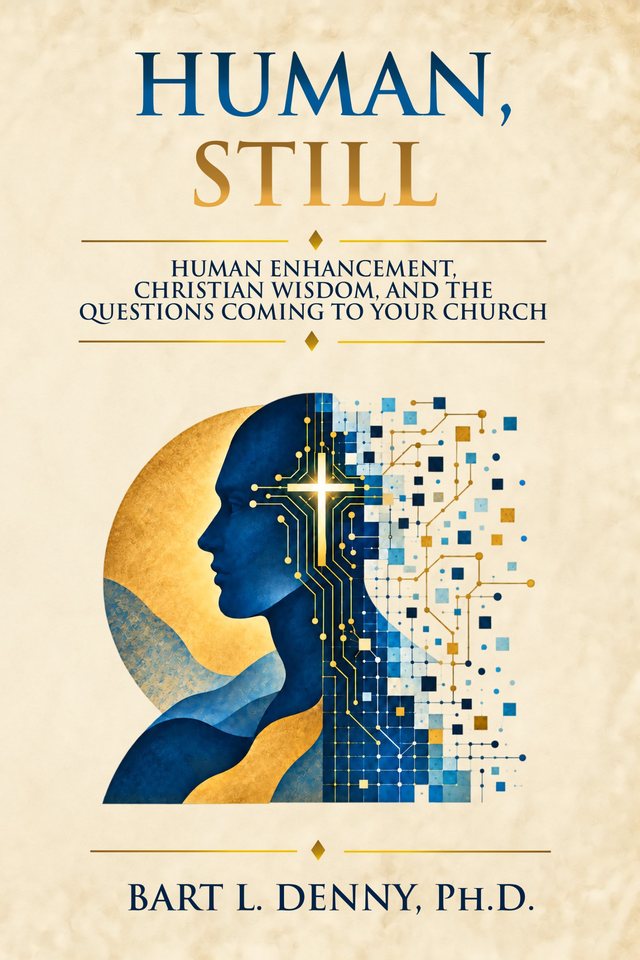
These questions are going to reach most churches long before most churches are ready for them, often by way of a family facing a hard medical decision. Human, Still: Human Enhancement, Christian Wisdom, and the Questions Coming to Your Church takes them up at length, across genetics, AI, neurotechnology, reproductive medicine and life-extension research. It isn’t a list of rules. Its test is whether the future being offered to us looks like the humanity revealed in Jesus Christ.
You can read the introduction and first chapter free from the book page.